By Maruxa Cardama, Secretary General of SLOCAT, Joo Hyun Ha, Head of Advocacy at UIC, Philip Turner, Head of Sustainable Development at UITP, Bronwen Thornton, CEO of Walk21, and Ben Welle, Director Integrated Transport & Innovation at WRI
Transport is the world’s fastest growing source of carbon dioxide (CO2) emissions, accounting for 21.9% of global emissions in 2023. Yet, despite its disproportionate role in the climate crisis, current national climate plans, known as Nationally Determined Contributions (NDCs) fall significantly short of aligning the sector with the 1.5°C target of the Paris Agreement on climate change. Closing this gap demands urgent, decisive, and bold efforts across all transport modes.
2025: A defining moment for climate action in transport
Ahead of the UN Climate Change Conference (UNFCCC COP 30) in Belém, Brazil, in November this year, countries are required to submit new NDCs with targets extending to 2035. The Conference is expected to shape the ambition, speed, and financing for global climate action. 2025 also marks the eve of the UN Decade of Sustainable Transport, which creates a pivotal opportunity to accelerate the transition towards sustainable, low-carbon, resilient, and just transport systems globally.
NDCs can inspire more ambitious climate mitigation policies for transport while reducing health damaging air and noise pollution, cutting reliance on fossil fuels, boosting resilience to global shocks, attracting investment, and creating jobs. But for this to happen, we need ambitious targets and strong policies, backed by sufficient funding.
What will it take to align transport with a net-zero pathway?
The new NDCs can enable policymakers to set ambitious emission reduction targets for transport, aligned with net-zero pathways by 2050. To be effective, these targets must be embedded in supportive policies and incentives. Crucially, when developing these, policymakers must be guided by the recommendations of the first Global Stocktake (GST) adopted at COP 28. These recommendations call on countries to accelerate the reduction of emissions from road transport on a range of pathways, including through the development of infrastructure and rapid deployment of zero- and low-emission vehicles, while phasing out fossil fuels in a just, orderly, and equitable manner to achieve net-zero emissions by 2050.
Unleashing the full potential of mitigation actions calls for parallel adaptation measures to boost the sector’s resilience. Under the current policy scenario, transport can experience a near total (97.8%) infrastructure loss by 2050, the most severe compared to any other sector. Beyond the staggering financial losses in transport assets, climate-related transport disruptions severely impact a country’s connectivity and development. Adaptation and resilience should thus be at the core of new NDCs, with measures ranging from the design of flood-protected buses and cycle lanes to locally powered electric recharging infrastructure.
Delivering clean transport solutions worldwide will cost an estimated USD 2.7 trillion annually until 2050 – seven times the current spending on transport. New NDCs present critical opportunities for countries to boost both mitigation and adaptation funding for transport while supporting broader financial and economic reforms. The phase-out of harmful and counterproductive fossil fuel subsidies, for instance, is key to accelerating the shift toward zero-emission and resilient transport systems, while unlocking new funding streams for the sector.
Early movers: What are the positive transport elements in new NDCs?
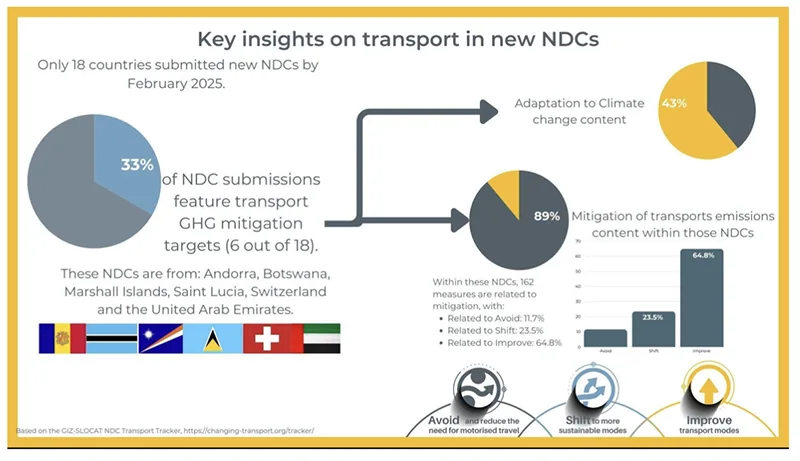
As of March 2025, 21 countries have submitted their new NDCs to the UNFCCC Secretariat, with 15 integrating transport-specific mitigation and/or adaptation targets and actions. Switzerland’s NDC, for instance, aims to cut national transport emissions by 41% by 2035, 57% by 2040, and 100% by 2050 compared to 1990 levels. Additionally, transport emission reduction targets are featured in the new NDCs of Andorra, Botswana, the Marshall Islands, Saint Lucia, and the United Arab Emirates (UAE).
The NDCs of Singapore, Switzerland, and the UAE establish direct links between proposed land transport actions and the Global Stocktake outcomes. Singapore’s NDC sets concrete targets to expand metro rail networks, build cycling lanes, and improve walking infrastructure. The NDCs of Brazil, Lesotho, Switzerland, the US, and Uruguay emphasise “avoid” and “shift” measures, for example modal shift targets, public transit expansion, and investment in active mobility infrastructure. Such types of measures could deliver 40-60% of transport emission reductions at lower costs than “improve” strategies such as electrification.
Lesotho’s NDC incorporates strong transport adaptation and resilience targets and measures, including strengthened standards for climate-proof roads and enhanced integration of multi-hazard risk assessment vulnerability planning by 2025. Moreover, these actions are directly linked to the implementation of the SDGs. Connecting transport measures to climate, sustainability, and just transition allows countries to simultaneously transform their transport systems, economies, and societies.
Saint Lucia’s NDC emphasizes investment with plans to finance charging infrastructure, provide fiscal incentives, and purchase support to stimulate the uptake of electric vehicles (EVs). The UK’s NDC reflects approaches to prioritizing people in the transition to low-carbon, sustainable, and resilient transport with references to dedicated programmes on just transition for workers, communities, and businesses.
Amplifying transport best practices ahead of COP 30 and beyond
The Intergovernmental Panel on Climate Change (IPCC) warns that transport greenhouse gas (GHG) emissions need to be reduced by at least 59% compared to 2020 levels in order to keep within the 1.5°C target. The upcoming NDCs and the approaching UN Decade of Sustainable Transport present crucial opportunities for policy change and investment.
Countries must seize these opportunities by setting concrete and ambitious transport targets, backing them with robust policy frameworks, specific actions, and financial resources while placing people at the heart of these efforts. NDCs under preparation can further build on the positive transport elements identified in early submissions by prioritizing a full range of “avoid” and “shift” solutions while, more broadly, favoring integrated transport planning – all in close coordination with sub-national governments.
Policymakers do not have to start from scratch and can benefit from a wealth of guidance documents and technical resources by specialized transport actors. Some examples are the general NDC guidance for transport by the German Development Agency (GIZ), the Organisation for Economic Co-operation and Development’s (OECD) International Transport Forum (ITF), and the Climate Champions Team, as well as the mode- and sector-specific guidance for public transport by the International Association of Public Transport (UITP), railways by the International Union on Railways (UIC), active mobility by the Partnership for Active Travel and Health (PATH), and popular transport by the Global Network for Popular Transport (GNPT). These and other materials are compiled on the NDCs 3.0 Library by the SLOCAT Partnership on Sustainable, Low-Carbon Transport.